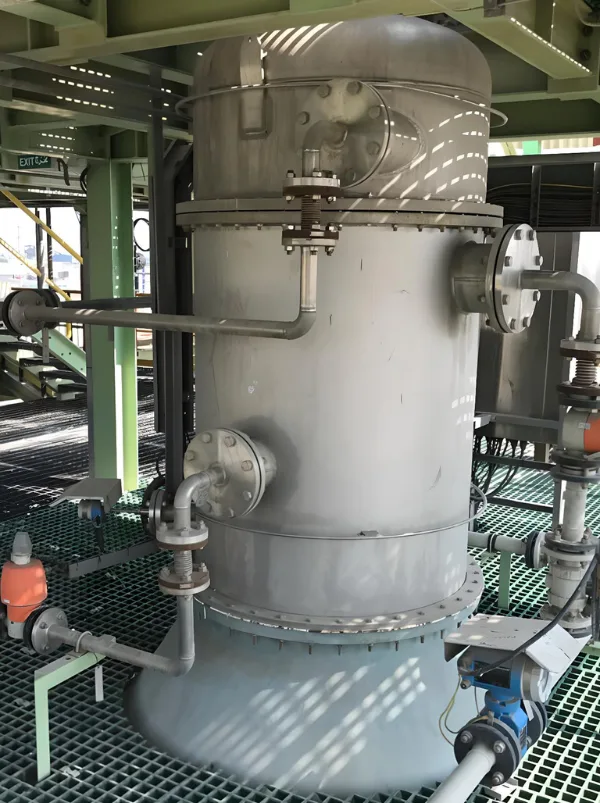
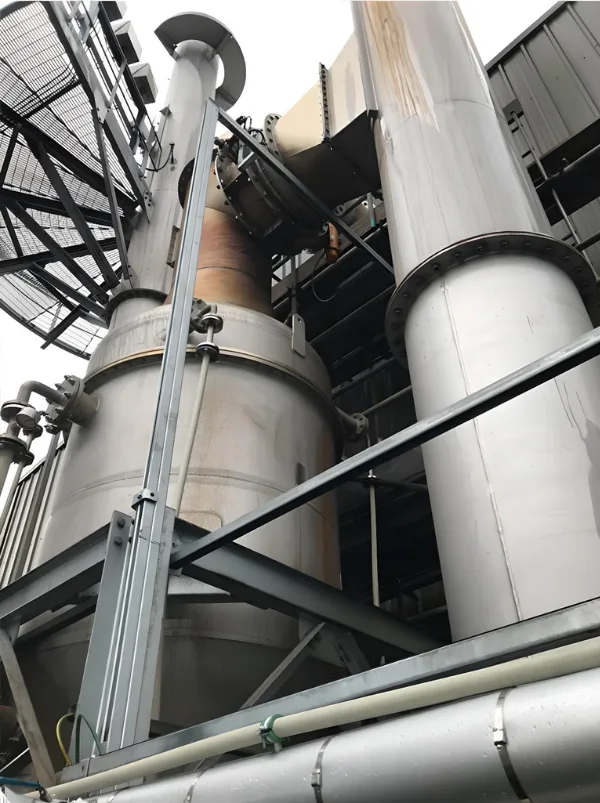
Quench vessels are used to rapidly cool hot flue gas, process gas, or syngas. ERG has extensive experience of high-temperature quenching as the first stage of a wet gas cleaning package. See examples of typical applications here.
A quench vessel is usually configured for vertical gas flow, with the inlet nozzle at the top. The hot gas enters the vessel and is immediately sprayed with the quench liquor. The gas is cooled by a process called adiabatic saturation — a portion of the sprayed quench liquor evaporates, and the energy required for this evaporation is taken from the hot gas, causing its temperature to drop. The gas cools to what is known as the adiabatic saturation temperature, or quench temperature, which depends on the inlet gas temperature, humidity, and dry gas composition. The quenched gas then passes to the next treatment stage of the gas cleaning package, and the remaining quench liquor drains under gravity into a sump tank, from where it is recirculated back to the top of the quench vessel.
The inlet gas temperature is dependent on the process. ERG has experience in providing quench vessels for:
As well as quench vessels as described, ERG can also provide partial quenches using air or water to reduce the gas temperature without achieving complete adiabatic saturation.
ERG quench vessels are provided as part of complete scrubbing packages, with the necessary sump tank, expansion bellows, fan, ductwork, pump, pipework and controls. In the majority of applications, the quench is combined with other ERG heat transfer equipment (venturi, tray tower, packed tower, V tex® scrubber, etc).
Refer to our other mass transfer technologies for full details of the range.
ERG (Air Pollution Control) Ltd
Bridge House Lane
Five Oaks Road, Slinfold, Horsham
West Sussex, RH13 0QW, UK

Industrial gas cleaning/Thermal systems

System Maintenance

Odour control

Plastic-GRP Fabrication